
Confirm, edit or call back.
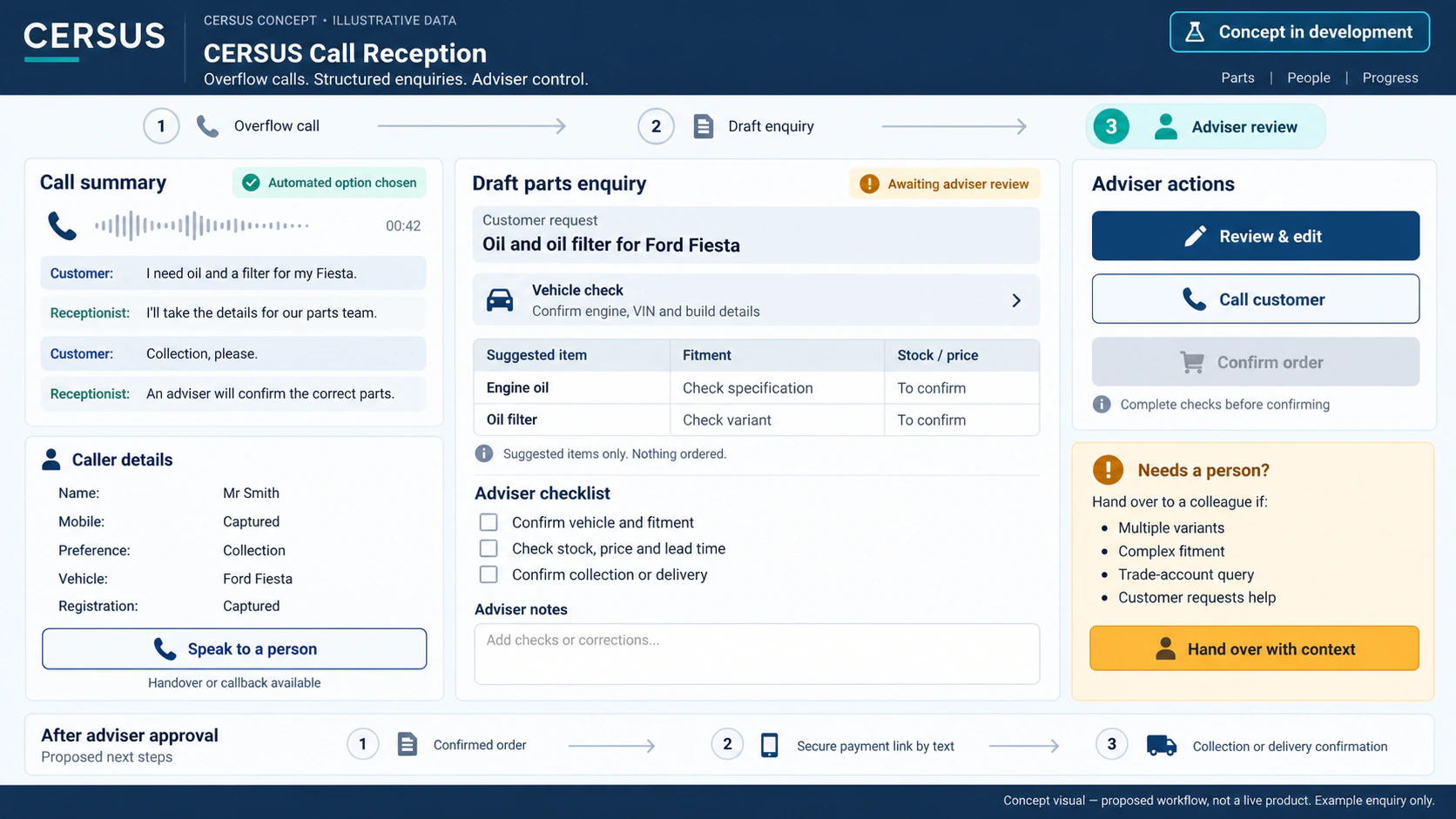
A draft arrives with the call summary, vehicle details, customer request and suggested matches. The parts adviser decides what happens next.
Call Reception · CERSUS Blog
A customer who cannot get through rarely waits forever. They ring the next parts department.
This is a concept we have been shaping: use an AI receptionist for suitable overflow calls, but keep identification, fitment and the final order under human control.
The familiar problem
A busy parts department can be doing good business and still lose the next enquiry. Advisors are checking fitment, finding stock, receiving deliveries and serving the counter. Adding enough people to answer every call may not make commercial sense, but every unanswered call can still become somebody else's sale.
The useful question is not whether technology should replace a parts adviser. It is whether a simple call can be captured properly when an adviser is not free.
A customer example
The customer chooses the automated option because the parts team is busy. The receptionist asks for the registration, confirms the vehicle, understands the parts request and checks the likely stock position. If the request is clear, it prepares the enquiry for the parts team. If it is not clear, it says so.
Understand whether this is a new enquiry, an order update or a call for a person.
Ask for the registration and read the vehicle details back for confirmation.
Capture the customer's words, position or side and any preference that matters.
Look for likely matches, price, stock and lead time in the parts system.
Capture the customer's name, mobile number and collection or delivery preference.
Give the adviser the call summary, vehicle and suggested parts before anything is confirmed.
The human checkpoint
Parts fitment is exactly where confidence matters. Similar vehicles can have different variants, and a description that sounds simple can still depend on VIN, engine or build detail. The call receptionist should never bluff.
A draft arrives with the call summary, vehicle details, customer request and suggested matches. The parts adviser decides what happens next.
Low confidence, multiple variants, a frustrated customer, trade-account questions or complex fitment should move to a person with the useful context already captured.
Once an adviser confirms the order, the customer could receive a secure payment link by text, followed by a collection or delivery confirmation.
What this could improve
The parts team gets a structured enquiry instead of a missed-call list, while the customer gets an answer or a clear next step without repeating the whole story.
What it should never do
The customer must always be able to ask for a person. Complex calls need a warm handover, not another automated dead end.
A concept in development
Tell Kevin what your busiest calls sound like, which ones are straightforward and where a human parts adviser must take over.